Monday, December 29, 2014
Becoming Richard Pryor
A major biography—intimate, gripping, revelatory—of an artist who revolutionized American comedy.
Richard Pryor may have been the most unlikely star in Hollywood history. Raised in his family’s brothels, he grew up an outsider to privilege. He took to the stage, originally, to escape the hard-bitten realities of his childhood, but later came to a reverberating discovery: that by plunging into the depths of his experience, he could make stand-up comedy as exhilarating and harrowing as the life he’d known. He brought that trembling vitality to Hollywood, where his movie career—Blazing Saddles, the buddy comedies with Gene Wilder, Blue Collar—flowed directly out of his spirit of creative improvisation. The major studios considered him dangerous. Audiences felt plugged directly into the socket of life.
Becoming Richard Pryor brings the man and his comic genius into focus as never before. Drawing upon a mountain of original research—interviews with family and friends, court transcripts, unpublished journals, screenplay drafts—Scott Saul traces Pryor’s rough journey to the heights of fame: from his heartbreaking childhood, his trials in the Army, and his apprentice days in Greenwich Village to his soul-searching interlude in Berkeley and his ascent in the “New Hollywood” of the 1970s.
Becoming Richard Pryor illuminates an entertainer who, by bringing together the spirits of the black freedom movement and the counterculture, forever altered the DNA of American comedy. It reveals that, while Pryor made himself a legend with his own account of his life onstage, the full truth of that life is more bracing still.
Strong Inside: Perry Wallace and the Collision of Race and Sports in the South
Based on more than eighty interviews, this fast-paced, richly detailed biography of Perry Wallace, the first African American basketball player in the SEC, digs deep beneath the surface to reveal a more complicated and profound story of sports pioneering than we've come to expect from the genre. Perry Wallace's unusually insightful and honest introspection reveals his inner thoughts throughout his journey.
Wallace entered kindergarten the year that Brown v. Board of Education upended "separate but equal." As a 12-year-old, he sneaked downtown to watch the sit-ins at Nashville's lunch counters. A week after Martin Luther King Jr.'s "I Have a Dream" speech, Wallace entered high school, and later saw the passage of the Civil Rights and Voting Rights acts. On March 16, 1966, his Pearl High School basketball team won Tennessee's first integrated state tournament--the same day Adolph Rupp's all-white Kentucky Wildcats lost to the all-black Texas Western Miners in an iconic NCAA title game.
The world seemed to be opening up at just the right time, and when Vanderbilt recruited him, Wallace courageously accepted the assignment to desegregate the SEC. His experiences on campus and in the hostile gymnasiums of the Deep South turned out to be nothing like he ever imagined.
On campus, he encountered the leading civil rights figures of the day, including Stokely Carmichael, Martin Luther King Jr., Fannie Lou Hamer, and Robert Kennedy--and he led Vanderbilt's small group of black students to a meeting with the university chancellor to push for better treatment.
On the basketball court, he experienced an Ole Miss boycott and the rabid hate of the Mississippi State fans in Starkville. Following his freshman year, the NCAA instituted "the Lew Alcindor rule," which deprived Wallace of his signature move, the slam dunk.
Despite this attempt to limit the influence of a rising tide of black stars, the final basket of Wallace's college career was a cathartic and defiant dunk, and the story Wallace told to the Vanderbilt Human Relations Committee and later The Tennessean was not the simple story of a triumphant trailblazer that many people wanted to hear. Yes, he had gone from hearing racial epithets when he appeared in his dormitory to being voted as the university's most popular student, but, at the risk of being labeled "ungrateful," he spoke truth to power in describing the daily slights and abuses he had overcome and what Martin Luther King had called "the agonizing loneliness of a pioneer."
0826520235
All Eyes are Upon Us: Race and Politics from Boston to Brooklyn
The Northeastern United States—home to abolitionism and a refuge for blacks fleeing the Jim Crow South—has had a long and celebrated history of racial equality and political liberalism. After World War II, the region appeared poised to continue this legacy, electing black politicians and rallying behind black athletes and cultural leaders. However, as historian Jason Sokol reveals in All Eyes Are Upon Us, these achievements obscured the harsh reality of a region riven by segregation and deep-seated racism.
White fans from across Brooklyn—Irish, Jewish, and Italian—came out to support Jackie Robinson when he broke baseball’s color barrier with the Dodgers in 1947, even as the city’s blacks were shunted into segregated neighborhoods. The African-American politician Ed Brooke won a senate seat in Massachusetts in 1966, when the state was 97% white, yet his political career was undone by the resistance to busing in Boston. Across the Northeast over the last half-century, blacks have encountered housing and employment discrimination as well as racial violence. But the gap between the northern ideal and the region’s segregated reality left small but meaningful room for racial progress. Forced to reckon with the disparity between their racial practices and their racial preaching, blacks and whites forged interracial coalitions and demanded that the region live up to its promise of equal opportunity.
A revelatory account of the tumultuous modern history of race and politics in the Northeast, All Eyes Are Upon Us presents the Northeast as a microcosm of America as a whole: outwardly democratic, inwardly conflicted, but always striving to live up to its highest ideals.
046502226X
Free Stylin': How Hip Hop Changed the Fashion Industry
For years, designers and manufacturers took cues from the streets to enhance their clothing lines, but before the 1980s the urban consumer was never recognized as a viable demographic. In a push to appeal to young customers, the fashion industry began hiring and backing talented African American designers and entrepreneurs. This seemingly unconventional union made business sense: seasoned fashion executives brought proven track records, while aspiring designers provided street credibility and a fresh perspective on design. The end result: a multi-billion dollar industry.
This book traces the fascinating unfolding of hip hop fashion from its roots to the present day. It explores how hip hop transitioned from "the hood" to the runway; how race, ethnicity, and culture played into commercialism; how celebrities impacted the fashion industry; and what ultimately led major department stores to jump on the urban bandwagon. Utilizing the author's journalistic lens and based upon interviews with urban fashion designers, entrepreneurs, fashion veterans, trend forecasters, and hip hop celebrities, each chapter is akin to an oral history that provides not just facts but also invaluable analysis and historical perspective.
0313386463
Friday, December 26, 2014
The Great Negro Plot: A Tale of Conspiracy and Murder in Eighteenth
In 1741, New York City was thrown into an uproar when a sixteen-year-old white woman, an indentured servant named Mary Burton, testified that she was privy to a monstrous conspiracy against the white people of Manhattan. Promised her freedom by authorities if she would only uncover the plot, Mary reported that the black men of the city were planning to burn New York City to the ground. As the courts ensnared more and more suspects and violence swept the city, 154 black New Yorkers were jailed, 14 were burned alive, 18 were hanged, and more than 100 simply "disappeared"; four whites wound up being executed and 24 imprisoned. Even as the madness escalated, however, officials started to realize that Mary Burton might not be telling the truth.
Expertly written by the acclaimed author of Drop and Hunting in Harlem, The Great Negro Plot is a brilliant reconstruction of a little-known moment in American history whose echoes still reverberate today.
mat johnson - the great negro plot- a tale of conspiracy and murder in eighteenth-century new york _retail_ _epub_
Thursday, December 25, 2014
1919, The Year of Racial Violence: How African Americans Fought Back
1919, The Year of Racial Violence recounts African Americans' brave stand against a cascade of mob attacks in the United States after World War I. The emerging New Negro identity, which prized unflinching resistance to second-class citizenship, further inspired veterans and their fellow black citizens. In city after city - Washington, DC; Chicago; Charleston; and elsewhere - black men and women took up arms to repel mobs that used lynching, assaults, and other forms of violence to protect white supremacy; yet, authorities blamed blacks for the violence, leading to mass arrests and misleading news coverage. Refusing to yield, African Americans sought accuracy and fairness in the courts of public opinion and the law. This is the first account of this three-front fight - in the streets, in the press, and in the courts - against mob violence during one of the worst years of racial conflict in U.S. history.
1919_ The Year of Racial Violen - David F. Krugler
Spike Lee: Finding the Story and Forcing the Issue
This insightful study probes the iconic filmmaker's career as a director and shaper of American culture. It not only sheds light on the ways in which Lee's background, influences, and outlook affect his films but also discusses how he participates in, transforms, and transcends the tradition of black American filmmaking.
Each chapter offers a critical assessment of at least one, and sometimes multiple, Lee films, examining their production history; their place in Lee's filmography; and their aesthetic, cultural, and historical significance. Readers will come away from this first scholarly assessment of Lee's career and work with a better understanding of his penchant for stirring up controversy about significant social, political, and artistic issues as well as his role as an American artist who provokes his audiences as much as he pacifies them.
0313392269Lee
Empower the People: Overthrow The Conspiracy That Is Stealing Your Money And Freedom
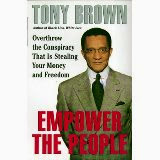
In the follow-up to his very successful Black Lies, White Lies, controversial talk-show host and radio commentator Tony Brown presents a practical plan to reclaim our resources and institutions from a selfish and exclusive power elite.
At the start of the twentieth century, argues Tony Brown, the world's economy was hijacked. In capitalist and communist countries alike, elitist groups took control of international trade and national banks, with dire results for the ordinary citizen. Ever since, capital has moved toward a single inner circle -- the Ruling Class Conspiracy -- who monopolize the world's markets and even its governments for personal profit. Their stratagems range from the "war" against drugs to deliberately induced racial conflict among ethnic groups in America -- none in earnest, all carefully designed to preserve a pernicious status quo.
But Tony Brown has a remedy. His provocative and empowering seven-step plan offers an opportunity to break free once and for all from the constricting control of the wealthy and powerful who have run the world for far too long -- including a point-by-point program for radical reform of the income tax and a proposal to muzzle the Federal Reserve Bank, which exerts unconscionable influence over the lives of every American.
Incendiary and persuasive, this book reaches beyond race to claim the high ground of historical, logical, and moral analysis. For nearly half a century of Cold War, America and the Free World were defined by opposition to Communism...but was this merely a red herring to ensure the domination of the haves over the have-nots? Read Empower the People, form your own conclusions...and hit the brakes!
Empower_the_People_Overthrow_The_Con
Spike Lee's America
Spike Lee has directed, written, produced, and acted in dozens of films that present an expansive, nuanced, proudly opinionated, and richly multifaceted portrait of American society. As the only African-American filmmaker ever to establish a world-class career, Lee has paid acute attention to the experiences of racial and ethnic minorities. But white men and women also play important roles in his movies, and his interest in class, race, and urban life hasn’t prevented his films from ranging over broad swaths of the American scene in stories as diverse as the audiences who view them. His defining trait is a willingness to raise hard questions about contemporary America without pretending to have easy answers; his pictures are designed to challenge and provoke us, not ease our minds or pacify our emotions. The opening words of his 1989 masterpiece Do the Right Thing present his core message in two emphatic syllables: “Wake up!”
Spike Lee’s America is a vibrant and provocative engagement not only with the work of a great filmmaker, but also with American society and politics.
0745651828_spike
Tuesday, December 23, 2014
A Cuban Boxer's Journey: Guillermo Rigondeaux, from Castro's Traitor to American Champion
THE STORY OF CUBAN BOXER AND POLITICAL PARIAH GUILLERMO RIGONDEAUX'S HARROWING DECISION TO DEFECT IN HOPES OF REAPING THE REWARDS OF THE AMERICAN DREAM
“What is one million dollars compared to the love of eight million Cubans?”
This was the question posed by legendary boxer Teofilo Stevenson in the 1970s, crowned by many as the Muhammad Ali of Cuba, in response to an offer of five million dollars to leave his island to fight Ali. But not all Cubans have come to the same conclusion, let alone with such apparent ease. Guillermo Rigondeaux, two-time Olympic champion and heir to Stevenson’s throne, sacrificed everything he had in his home country—his wife, his son, his government-subsidized car and house, as well as universal reverence among his fellow citizens—to try to make it in the mecca of big-money boxing, the United States of America. But has the chance to make good in America been worth the loss of his national identity and the love of his countrymen? And to what extent has he been corrupted by the promise of untold riches?
In A Cuban Boxer’s Journey, author, filmmaker, and journalist Brin-Jonathan Butler chronicles the fascinating and tumultuous career of Rigondeaux—moody, driven, and almost mythically talented––as he attempts to capture the elusive and often punishing American dream. See how this athlete’s most daunting challenge becomes how he can survive the complex forces outside of the ring.
1250044707cbj
Culture @ the Cutting Edge: Tracking Caribbean Popular Music
The anglophone Caribbean has long been celebrated and known for its vibrant and innovative music. Reggae, dancehall, calypso, soca, gospel and ringbang have flourished within the Caribbean and have exploded on the worldwide stage. This work deliberately moves away from the customary exclusive focus on Trinidad and Jamaica and broadens the discourse to represent the wider region. It addresses several topics which remain under-discussed in Caribbean music, such as the status of Caribbean gospel; the birth of new musical styles in the Eastern Caribbean; cultural misrepresentation in Caribbean music videos; the representation of AIDS in Caribbean music; and the impact of the actual music technology utilized by Caribbean musicians in the last twenty years.
[Curwen_Best]_Culture__the_Cutting_Edge_Tracking_Bokos-Z1_
Hip Hop Africa: New African Music in a Globalizing World
Hip Hop Africa explores a new generation of Africans who are not only consumers of global musical currents, but also active and creative participants. Eric Charry and an international group of contributors look carefully at youth culture and the explosion of hip hop in Africa, the embrace of other contemporary genres, including reggae, ragga, and gospel music, and the continued vitality of drumming. Covering Senegal, Mali, Côte d'Ivoire, Ghana, Nigeria, Kenya, Tanzania, Malawi, and South Africa, this volume offers unique perspectives on the presence and development of hip hop and other music in Africa and their place in global music culture.
Hip-Hop Africa New African Music in a Globalization World [Ed. by Eric Charry] _2012_
Monday, December 22, 2014
Stuck in Place: Urban Neighborhoods and the End of Progress toward Racial Equality
In the 1960s, many believed that the civil rights movement’s successes would foster a new era of racial equality in America. Four decades later, the degree of racial inequality has barely changed. To understand what went wrong, Patrick Sharkey argues that we have to understand what has happened to African American communities over the last several decades. In Stuck in Place, Sharkey describes how political decisions and social policies have led to severe disinvestment from black neighborhoods, persistent segregation, declining economic opportunities, and a growing link between African American communities and the criminal justice system.
As a result, neighborhood inequality that existed in the 1970s has been passed down to the current generation of African Americans. Some of the most persistent forms of racial inequality, such as gaps in income and test scores, can only be explained by considering the neighborhoods in which black and white families have lived over multiple generations. This multigenerational nature of neighborhood inequality also means that a new kind of urban policy is necessary for our nation’s cities. Sharkey argues for urban policies that have the potential to create transformative and sustained changes in urban communities and the families that live within them, and he outlines a durable urban policy agenda to move in that direction.
0226924254
Down Second Avenue by Es'kia Mphahlele and Ngugi wa Thiong'o
Nominated for the Nobel Prize in 1969, Es’kia Mphahlele is considered the Dean of African Letters and the father of black South African writing. Down Second Avenue is a landmark book that describes Mphahlele’s experience growing up in segregated South Africa. Vivid, graceful, and unapologetic, it details a daily life of severe poverty and brutal police surveillance under the subjugation of an apartheid regime. Banned in South Africa after its original 1959 publication for its protest against apartheid, Down Second Avenue is a foundational work of literature that continues to inspire activists today.
down second avenue - es_kia mphahlele
Herbs and Other Cures: Rare Herbal Healing
Rare herbal plants and other cures is a natural way of life for many tribes. For centuries people have used herbal medicine this book has a well-formatted text on the most rarest herbal plants from African herbs to European herbs. A way to find out more about another form of treatment for many ailments.
herbsb00qzg1ss6
Saturday, December 20, 2014
Hollywood's African American Films: The Transition to Sound
In 1929 and 1930, during the Hollywood studios' conversion to synchronized-sound film production, white-controlled trade magazines and African American newspapers celebrated a "vogue" for "Negro films." "Hollywood's African American Films" argues that the movie business turned to black musical performance to both resolve technological and aesthetic problems introduced by the medium of "talking pictures" and, at the same time, to appeal to the white "Broadway" audience that patronized their most lucrative first-run theaters. Capitalizing on highbrow associations with white "slumming" in African American cabarets and on the cultural linkage between popular black musical styles and "natural" acoustics, studios produced a series of African American-cast and white-cast films featuring African American sequences. Ryan Jay Friedman asserts that these transitional films reflect contradictions within prevailing racial ideologies--arising most clearly in the movies' treatment of African American characters' decisions to migrate. Regardless of how the films represent these choices, they all prompt elaborate visual and narrative structures of containment that tend to highlight rather than suppress historical tensions surrounding African American social mobility, Jim Crow codes, and white exploitation of black labor.
0813550483
Whiting Up: Whiteface Minstrels and Stage Europeans in African American Performance
In the early 1890s, black performer Bob Cole turned blackface minstrelsy on its head with his nationally recognized whiteface creation, a character he called Willie Wayside. Just over a century later, hiphop star Busta Rhymes performed a whiteface supercop in his hit music video "Dangerous." In this sweeping work, Marvin McAllister explores the enduring tradition of "whiting up," in which African American actors, comics, musicians, and even everyday people have studied and assumed white racial identities.
Not to be confused with racial "passing" or derogatory notions of "acting white," whiting up is a deliberate performance strategy designed to challenge America's racial and political hierarchies by transferring supposed markers of whiteness to black bodies--creating unexpected intercultural alliances even as it sharply critiques racial stereotypes. Along with conventional theater, McAllister considers a variety of other live performance modes, including weekly promenading rituals, antebellum cakewalks, solo performance, and standup comedy. For over three centuries, whiting up as allowed African American artists to appropriate white cultural production, fashion new black identities through these "white" forms, and advance our collective ability to locate ourselves in others.
0807835080
Slave Songs of the United States
First published in 1867, Slave Songs of the United States represents the work of its three editors, all of whom collected and annotated these songs while working in the Sea Islands of South Carolina during the Civil War, and also of other collectors who transcribed songs sung by former slaves in other parts of the country. The transcriptions are preceded by an introduction written by William Francis Allen, the chief editor of the collection, who provides his own explanation of the origin of the songs and the circumstances under which they were sung. One critic has noted that, like the editors' introductions to slave narratives, Allen's introduction seeks to lend to slave expressions the honor of white authority and approval. Gathered during and after the Civil War, the songs, most of which are religious, reflect the time of slavery, and their collectors worried that they were beginning to disappear. Allen declares the editors' purpose to be to preserve, "while it is still possible… these relics of a state of society which has passed away."
080786949X
Friday, December 19, 2014
Operation Fly Trap: L. A. Gangs, Drugs, and the Law
In 2003, an FBI-led task force known as Operation Fly Trap attempted to dismantle a significant drug network in two Bloods-controlled, African American neighborhoods in Los Angeles. The operation would soon be considered an enormous success, noted for the precision with which the task force targeted and removed gang members otherwise entrenched in larger communities. In Operation Fly Trap, Susan A. Phillips questions both the success of this operation and the methods used to conduct it. Based on in-depth ethnographic research with Fly Trap participants, Phillips’s work brings together police narratives, crime statistics, gang cultural histories, and extensive public policy analysis to examine the relationship between state persecution and the genesis of violent social systems.
Crucial to Phillips’s contribution is the presentation of the voices and perspectives of both the people living in impoverished communities and the agents that police them. Phillips positions law enforcement surveillance and suppression as a critical point of contact between citizen and state. She tracks the bureaucratic workings of police and FBI agencies and the language, ideologies, and methods that prevail within them, and shows how gangs have adapted, seeking out new locations, learning to operate without hierarchies, and moving their activities more deeply underground. Additionally, she shows how the targeted efforts of task forces such as Fly Trap wreak sweeping, sustained damage on family members and the community at large. Balancing her roles as even-handed reporter and public scholar, Phillips presents multiple flaws within the US criminal justice system and builds a powerful argument that many law enforcement policies in fact nurture, rather than prevent, violence in American society.
0226667669_0226667650Operat
On the Run: Fugitive Life in an American City
Forty years in, the War on Drugs has done almost nothing to prevent drugs from being sold or used, but it has nonetheless created a little-known surveillance state in America’s most disadvantaged neighborhoods. Arrest quotas and high-tech surveillance techniques criminalize entire blocks, and transform the very associations that should stabilize young lives—family, relationships, jobs—into liabilities, as the police use such relationships to track down suspects, demand information, and threaten consequences.
Alice Goffman spent six years living in one such neighborhood in Philadelphia, and her close observations and often harrowing stories reveal the pernicious effects of this pervasive policing. Goffman introduces us to an unforgettable cast of young African American men who are caught up in this web of warrants and surveillance—some of them small-time drug dealers, others just ordinary guys dealing with limited choices. All find the web of presumed criminality, built as it is on the very associations and friendships that make up a life, nearly impossible to escape. We watch as the pleasures of summer-evening stoop-sitting are shattered by the arrival of a carful of cops looking to serve a warrant; we watch—and can’t help but be shocked—as teenagers teach their younger siblings and cousins how to run from the police (and, crucially, to keep away from friends and family so they can stay hidden); and we see, over and over, the relentless toll that the presumption of criminality takes on families—and futures.
While not denying the problems of the drug trade, and the violence that often accompanies it, through her gripping accounts of daily life in the forgotten neighborhoods of America's cities, Goffman makes it impossible for us to ignore the very real human costs of our failed response—the blighting of entire neighborhoods, and the needless sacrifice of whole generations.
022613671xontherun
Kahuna Healing
The author sets forth the ancient Hawaiian tradition which includes a complete program for the prevention and cure of illness---a holistic health program involving the physical, emotional, mental, and spiritual aspects of human beings.
0835605728
Mississippi John Hurt: His Life, His Times, His Blues
When Mississippi John Hurt (1892-1966) was "rediscovered" by blues revivalists in 1963, his musicianship and recordings transformed popular notions of prewar country blues. At seventy-one he moved to Washington, D.C., from Avalon, Mississippi, and became a live-wire connection to a powerful, authentic past. His intricate and lively style made him the most sought after musician among the many talents the revival brought to light.
Mississippi John Hurt provides this legendary creator's life story for the first time. Biographer Philip Ratcliffe traces Hurt's roots to the moment his mother Mary Jane McCain and his father Isom Hurt were freed from slavery. Anecdotes from Hurt's childhood and teenage years include the destiny-making moment when his mother purchased his first guitar for $1.50 when he was only nine years old. Stories from his neighbors and friends, from both of his wives, and from his extended family round out the community picture of Avalon. U.S. census records, Hurt's first marriage record in 1916, images of his first autographed LP record, and excerpts from personal letters written in his own hand provide treasures for fans. Ratcliffe details Hurt's musical influences and the origins of his style and repertoire. The author also relates numerous stories from the time of his success, drawing on published sources and many hours of interviews with people who knew Hurt well, including the late Jerry Ricks, Pat Sky, Stefan Grossman and Max Ochs, Dick Spottswood, and the late Mike Stewart. In addition, some of the last photographs taken of the legendary musician are featured for the first time in Mississippi John Hurt.
1617030082
Sacred Steel: Inside an African American Steel Guitar Tradition
In this book, Robert L. Stone follows the sound of steel guitar into the music-driven Pentecostal worship of two related churches: the House of God and the Church of the Living God. A rare outsider who has gained the trust of members and musicians inside the church, Stone uses nearly two decades of research, interviews, and fieldwork to tell the story of a vibrant musical tradition that straddles sacred and secular contexts.
Most often identified with country and western bands, steel guitar is almost unheard of in African American churches--except for the House of God and the Church of the Living God, where it has been part of worship since the 1930s. Sacred Steel traces the tradition through four generations of musicians and in some two hundred churches extending across the country from Florida to California, Michigan to Alabama. Presenting detailed portraits of musical pioneers such as brothers Troman and Willie Eason and contemporary masters such as Chuck Campbell, Glenn Lee, and Robert Randolph, Stone expertly outlines the fundamental tensions between sacred steel musicians and church hierarchy.
In this thorough analysis of the tradition, Stone explores the function of the music in church meetings and its effect on the congregations. He also examines recent developments such as the growing number of female performers, the commercial appeal of the music, and younger musicians' controversial move of the music from the church to secular contexts.
0252035542
Monday, December 15, 2014
Demonic Grounds: Black Women And The Cartographies Of Struggle
In a long overdue contribution to geography and social theory, Katherine McKittrick offers a new and powerful interpretation of black women’s geographic thought. In Canada, the Caribbean, and the United States, black women inhabit diasporic locations marked by the legacy of violence and slavery. Analyzing diverse literature and material geographies, McKittrick reveals how human geographies are a result of racialized connections, and how spaces that are fraught with limitation are underacknowledged but meaningful sites of political opposition.
Demonic Grounds moves between past and present, archives and fiction, theory and everyday, to focus on places negotiated by black women during and after the transatlantic slave trade. Specifically, the author addresses the geographic implications of slave auction blocks, Harriet Jacobs’s attic, black Canada and New France, as well as the conceptual spaces of feminism and Sylvia Wynter’s philosophies.
Central to McKittrick’s argument are the ways in which black women are not passive recipients of their surroundings and how a sense of place relates to the struggle against domination. Ultimately, McKittrick argues, these complex black geographies are alterable and may provide the opportunity for social and cultural change.
Katherine McKittrick is assistant professor of women’s studies at Queen’s University.
[Katherine_McKittrick]_Demonic_Grounds_Black_Wome_Bokos-Z1_
Racial Prescriptions: Pharmaceuticals, Difference, and the Politics of Life
In the contemporary United States, matters of life and health have become key political concerns. Important to this politics of life is the desire to overcome racial inequalities in health; from heart disease to diabetes, the populations most afflicted by a range of illnesses are racialized minorities. The solutions generally proposed to the problem of racial health disparities have been social and environmental in nature, but in the wake of the mapping of the human genome, genetic thinking has come to have considerable influence on how such inequalities are problematized. Racial Prescriptions explores the politics of dealing with health inequities through targeting pharmaceuticals at specific racial groups based on the idea that they are genetically different. Drawing on the introduction of BiDil to treat heart failure among African Americans, this book contends that while racialized pharmaceuticals are ostensibly about fostering life, they also raise thorny questions concerning the biologization of race, the reproduction of inequality, and the economic exploitation of the racial body.
Engaging the concept of biopower in an examination of race, genetics and pharmaceuticals, Racial Prescriptions will appeal to sociologists, anthropologists and scholars of science and technology studies with interests in medicine, health, bioscience, inequality and racial politics.
1409444988
Fighting the Devil in Dixie: How Civil Rights Activists Took on the Ku Klux Klan in Alabama
Shortly after the success of the Montgomery Bus Boycott, the Ku Klux Klan--determined to keep segregation as the way of life in Alabama--staged a resurgence, and the strong-armed leadership of governor George C. Wallace, who defied the new civil rights laws, empowered the Klan's most violent members. As Wallace’s power grew, however, blacks began fighting back in the courthouses and schoolhouses, as did young southern lawyers like Charles “Chuck” Morgan, who became the ACLU’s southern director; Morris Dees, who cofounded the Southern Poverty Law Center; and Bill Baxley, Alabama attorney general, who successfully prosecuted the bomber of Birmingham’s Sixteenth Street Baptist Church and legally halted some of Wallace’s agencies designed to slow down integration.
Fighting the Devil in Dixie is the first book to tell this story in full, from the Klan’s kidnappings, bombings, and murders of the 1950s to Wallace running for his fourth term as governor in the early 1980s, asking forgiveness and winning with the black vote
[Wayne_Greenhaw]_Fighting_the_devil_in_Dixie__how_Bokos-Z1_
Salem Health Magill's Medical Guide
Since 1995, Magill's Medical Guide has provided readers with the most authoritative yet accessible information about a variety of health and health-related topics. This new edition grows to six volumes and is an up-to-date, easy-to-use compendium of medical information suitable for student research as well as use by general readers, including patients and caregivers. Plus, complimentary online access is provided through Salem Health.
Salem_health
Saturday, December 13, 2014
Funk: The Music, The People, and The Rhythm of The One
Funk: It's the only musical genre ever to have transformed the nation into a throbbing army of bell-bottomed, hoop-earringed, rainbow-Afro'd warriors on the dance floor. Its rhythms and lyrics turned bleak urban realties inside out with distinctive, danceable, downright irresistible music.
Funk hasn't received the critical attention that rock, jazz, and the blues have-until now. Colorful, intelligent, and in-you-face, Rickey Vincent's Funk celebrates the songs, the musicians, the philosophy, and the meaning of funk. The book spans from the early work of James Brown (the Godfather of Funk) through today, covering funky soul (Stevie Wonder, the Temptations), so-called "black rock" (Jimi Hendrix, Sly and the Family Stone, the Isley Brothers), jazz-funk (Miles Davis, Herbie Hancock), monster funk (Parliament, Funkadelic, Bootsy's Rubber Band), naked funk (Rick James, Gap Band), disco-funk (Chic, K.C. and the Sunshine Band), funky pop (Kook & the Gang, Chaka Khan), P-Funk Hip Hop (Digital Underground, De La Soul), funk-sampling rap (Ice Cube, Dr. Dre), funk rock (Red Hot Chili Peppers, Primus), and more.
Funk tells a vital, vibrant history-the history of a uniquely American music born out of tradition and community, filled with energy, attitude, anger, hope, and an irrepressible spirit.
Nelson Mandela: An Extraordinary Life
Twentieth Century History Makers: Nelson Mandela offers a fascinating and complete look at one of the 20th century's great leaders and humanitarians. Beginning with his early life in a rural part of South Africa, the book traces the course of Mandela's life - his legal studies, helping to found the ANC, freedom fighting, trial for treason and harsh imprisonment. The story continues with Mandela's release from prison, the incredible story of the defeat of apartheid and his election as president, retirement, humanitarian activities and his death and funeral in 2013.
1445136449
Hi-De-Ho: The Life of Cab Calloway
Clad in white tie and tails, dancing and scatting his way through the "Hi-de-ho" chorus of "Minnie the Moocher," Cab Calloway exuded a sly charm and sophistication that endeared him to legions of fans.
In Hi-de-ho, author Alyn Shipton offers the first full-length biography of Cab Calloway, whose vocal theatrics and flamboyant stage presence made him one of the highest-earning African American bandleaders. Shipton sheds new light on Calloway's life and career, explaining how he traversed racial and social boundaries to become one of the country's most beloved entertainers. Drawing on first-hand accounts from Calloway's family, friends, and fellow musicians, the book traces the roots of this music icon, from his childhood in Rochester, New York, to his life of hustling on the streets of Baltimore. Shipton highlights how Calloway's desire to earn money to support his infant daughter prompted his first break into show business, when he joined his sister Blanche in a traveling revue. Beginning in obscure Baltimore nightclubs and culminating in his replacement of Duke Ellington at New York's famed Cotton Club, Calloway honed his gifts of scat singing and call-and-response routines. His career as a bandleader was matched by his genius as a talent-spotter, evidenced by his hiring of such jazz luminaries as Ben Webster, Dizzy Gillespie, and Jonah Jones. As the swing era waned, Calloway reinvented himself as a musical theatre star, appearing as Sportin' Life in "Porgy and Bess" in the early 1950s; in later years, Calloway cemented his status as a living legend through cameos on "Sesame Street" and his show-stopping appearance in the wildly popular "The Blues Brothers" movie, bringing his trademark "hi-de-ho" refrain to a new generation of audiences.
More than any other source, Hi-de-ho stands as an entertaining, not-to-be-missed portrait of Cab Calloway--one that expertly frames his enduring significance as a pioneering artist and entertainer.
0195141539
Search and Destroy: African-American Males in the Criminal Justice System 2nd Edition
An exploration into the criminal justice system in America today and its impact on young African American males, this book challenges the linking of crime and race and the conservative anti-welfare, hard-on-crime agenda. Jerry Miller has spent a lifetime studying and challenging our criminal justice system. He has worked to make it more progressive and more just. He has watched as it turned into a system of segregation and control for many Americans of color. That is the story told here in devastating detail. In this new edition, the author re-evaluates his original theses and places the book's predictions in a contemporary political context. The new edition includes new chapters as well as a new prologue and epilogue.
SearchDestroy
Wednesday, December 10, 2014
Princess Noire: The Tumultuous Reign of Nina Simone
Born Eunice Waymon in Tryon, North Carolina, Nina Simone (1933-2003) began her musical life playing classical piano. A child prodigy, she wanted a career on the concert stage, but when the Curtis Institute of Music rejected her, the devastating disappointment compelled her to change direction. She turned to popular music and jazz but never abandoned her classical roots or her intense ambition. By the age of twenty six, Simone had sung at New York City's venerable Town Hall and was on her way. Tapping into newly unearthed material on Simone's family and career, Nadine Cohodas paints a luminous portrait of the singer, highlighting her tumultuous life, her innovative compositions, and the prodigious talent that matched her ambition.
With precision and empathy, Cohodas weaves the story of Simone's contentious relationship with audiences and critics, her outspoken support for civil rights, her two marriages and her daughter, and, later, the sense of alienation that drove her to live abroad from 1993 until her death. Alongside these threads runs a more troubling one: Simone's increasing outbursts of rage and pain that signaled mental illness and a lifelong struggle to overcome a deep sense of personal injustice.
0807872431_0375424016Simone
Rock Art of the Caribbean
This compilation, by an international grouping of scholars, focuses on the nature of Caribbean rock art or rock graphics and makes clear the region's substantial and distinctive rock art tradition. Thorough and comparative, it includes data on the history of rock graphic research, the nature of the assemblages (image numbers, types, locations), and the legal, conservation, and research status of the image sites. Chapters on these topics cover research on the islands of Cuba, Haiti, Dominican Republic, the Bahamas, Jamaica, Puerto Rico, U.S. Virgin Islands, Guadeloupe, Aruba, and Bonaire. The prehispanic rock art and other ceremonial structures and artifacts, along with enthnohistorical accounts of the region at Contact, projected backward in time, all point to an active ritual and ceremonial life involving commoners, religious specialists, and elites in differing and interconnected roles and for diverse purposes. The selective use of common rock graphic design and physical elements can be seen in the distribution and execution of the carved and painted images. Pecked, ground, abraded, and scratched petroglyphs, along with pictographs done frequently in red, black, white and orange hues are found on a range of rock surfaces including limestones, granites, diorites, and andesites. Caves/rock shelters and rock formations associated with water sources (water ways, pools, ocean) account for the two most common locations, followed by ball court sites, inland rock outcroppings and beach rock.
In addition to specific area presentations, the work includes a review of recent advances in Caribbean rock graphic studies including dating and interpretative models; the application of a new documentation method and resulting computer manipulation advantages; a conservation project in Jamaica that has implications for the preservation and interpretation of the site; and a proposed dating sequence for the Lesser Antillean
Windward Islands
0817316507rock
Divas on Screen: Black Women in American Film
This insightful study places African American women's stardom in historical and industrial contexts by examining the star personae of five African American women: Dorothy Dandridge, Pam Grier, Whoopi Goldberg, Oprah Winfrey, and Halle Berry. Interpreting each woman's celebrity as predicated on a brand of charismatic authority, Mia Mask shows how these female stars have ultimately complicated the conventional discursive practices through which blackness and womanhood have been represented in commercial cinema, independent film, and network television.
Mask examines the function of these stars in seminal yet underanalyzed films. She considers Dandridge's status as a sexual commodity in films such as Tamango, revealing the contradictory discourses regarding race and sexuality in segregation-era American culture. Grier's feminist-camp performances in sexploitation pictures Women in Cages and The Big Doll House and her subsequent blaxploitation vehicles Coffy and Foxy Brown highlight a similar tension between representing African American women as both objectified stereotypes and powerful, self-defining icons. Mask reads Goldberg's transforming habits in Sister Act and The Associate as representative of her unruly comedic routines, while Winfrey's daily television performance as self-made, self-help guru echoes Horatio Alger narratives of success. Finally, Mask analyzes Berry's meteoric success by acknowledging the ways in which Dandridge's career made Berry's possible.
0252076192Divas
Tuesday, December 9, 2014
Blues Empress in Black Chattanooga: Bessie Smith and the Emerging Urban South
As one of the first African American vocalists to be recorded, Bessie Smith is a prominent figure in American popular culture and African American history. Michelle R. Scott uses Smith's life as a lens to investigate broad issues in history, including industrialization, Southern rural to urban migration, black community development in the post-emancipation era, and black working-class gender conventions.
Arguing that the rise of blues culture and the success of female blues artists like Bessie Smith are connected to the rapid migration and industrialization in the late nineteenth and early twentieth centuries, Scott focuses her analysis on Chattanooga, Tennessee, the large industrial and transportation center where Smith was born. This study explores how the expansion of the Southern railroads and the development of iron foundries, steel mills, and sawmills created vast employment opportunities in the postbellum era. Chronicling the growth and development of the African American Chattanooga community, Scott examines the Smith family's migration to Chattanooga and the popular music of black Chattanooga during the first decade of the twentieth century, and culminates by delving into Smith's early years on the vaudeville circuit.
0252075455_0252033388
US Army's First, Last, and Only All-Black Rangers: The 2d Ranger Infantry Company (Airborne) in the Korean War, 1950-1951
The 2d Ranger Infantry Company (Airborne) was the first and only all-black Ranger unit in the history of the United States Army. Its ten-month lifespan included selection, training, and seven months of combat deployment in Korea, after which the unit was deactivated. Edward Posey’s magnificent new study, now available in paperback, is the first complete history of this elite, all-volunteer unit, whose members were drawn from the 3rd Battalion of the 505th Airborne Infantry Regiment and the 80th Airborne Anti-Aircraft Battalion.
After experiencing the normal travails of boot camp at Fort Benning, which segregation and racism only made worse, the all-black Rangers set out to join the Korean War in late 1950. On January 7, 1951, the Rangers found themselves defending a critical railroad running through Tanyang Pass, which Communist guerillas tried to infiltrate. The nighttime action triggered the Rangers’ inaugural combat, which ended with the recommendation for a Bronze Star for gallantry for a Ranger sergeant. Additional combats with the North Korean and Communist Chinese forces erupted near Majori-ri and Chechon.
But the event that propelled the 2d Rangers into the record books was their airborne assault near Munsan-Ni on March 23, 1951—the first in Ranger history. Once on the ground, Posey and his comrades attacked and captured Hill 151. The fighting—often conducted at very close quarters, and some of it with the bayonet and rifle butt—demonstrated the courage of these tough African American soldiers. Heavy fighting marked their months at the front, including a magnificent attack and defense of Hill 581 that May. Throughout their deployment in Korea, the 2d Rangers served with honor and achieved an outstanding combat record.
Posey’s long overdue The US Army’s First, Last, and Only All-Black Rangers: The 2d Ranger Infantry Company (Airborne) in the Korean War, 1950-1951 (written with the help of other Rangers) is based upon the firsthand experiences of many members of the unit, official records, interviews with survivors, and other archival material. Stitched together, this information offers a rich and worthy addition to the growing literature on the Korean War by explaining the obstacles these patriotic African Americans faced, their sacrifices, and their courageous actions on the far side of the world.
Nearly sixty years have passed since the Korean War slipped into the realm of history. Now, the world will finally learn the true story of the United States Army’s first, last, and only all-black Ranger unit.
About the Author: Master Sergeant (Ret) Edward L. Posey joined the US Army in 1947. After serving with Company L, 3rd Battalion, 505th Airborne Infantry Regiment, he volunteered for airborne training with the Rangers in 1950 and served with distinction in the Korean War (where he was wounded). Sergeant Posey retired from the service in 1969. In 2002, he was inducted into the Ranger Hall of Fame for his dedication to duty and distinguished military career.
[edward_l._posey]_us_armys_first_last_and_only__bokos-z1_
Storming Caesar's Palace: How Black Mothers Fought Their Own War on Poverty
In Storming Caesars Palace, historian Annelise Orleck tells the compelling story of how a group of welfare mothers built one of this country's most successful antipoverty programs. Declaring "We can do it and do it better," these women proved that poor mothers are the real experts on poverty. In 1972 they founded Operation Life, which was responsible for many firsts for the poor in Las Vegas-the first library, medical center, daycare center, job training, and senior citizen housing. By the late 1970s, Operation Life was bringing millions of dollars into the community. These women became influential in Washington, DC-respected and listened to by political heavyweights such as Daniel Patrick Moynihan, Ted Kennedy, and Jimmy Carter. Though they lost their funding with the country's move toward conservatism in the 1980s, their struggles and phenomenal triumphs still stand as a critical lesson about what can be achieved when those on welfare chart their own course.
[Annelise_Orleck]_Storming_Caesar's_Palace_How_Bl_Bokos-Z1_
Follow Your Heart: Moving with the Giants of Jazz, Swing, and Rhythm and Blues
Detailing the fascinating career of Joe Evans, Follow Your Heart chronicles the nearly thirty years that he spent immersed in one of the most exciting times in African American music history. An alto saxophonist who between 1939 and 1965 performed with some of America's greatest musicians, including Louis Armstrong, Cab Calloway, Charlie Parker, Jay McShann, Andy Kirk, Billie Holiday, Bill "Bojangles" Robinson, Lionel Hampton, and Ivory Joe Hunter, Evans warmly recounts his wide range of experience in the music industry. Readers follow Evans from Pensacola, Florida, where he first learned to play, to such exotic destinations as Tel Aviv and Paris, which he visited while on tour with Lionel Hampton. Evans also comments on popular New York City venues used for shaping and producing black music, such as the Apollo Theater, the Savoy, Minton's Playhouse, and the Rhythm Club.
Revealing Evans as a master storyteller, Follow Your Heart describes his stints as a music executive, entrepreneur, and musician. Evans provides rich descriptions of jazz, swing, and rhythm and blues culture by highlighting his experiences promoting tracks to radio deejays under Ray Charles's Tangerine label and later writing, arranging, and producing hits for the Manhattans and the Pretenders. Leading numerous musical ventures that included a publishing company and several labels--Cee Jay Records (with Jack Rags), Revival, and Carnival Records--Evans remained active in the music industry even after he stopped performing regularly. As one of the few who enjoyed success as both performer and entrepreneur, he offers invaluable insight into race relations within the industry, the development of African American music and society from the 1920s to 1970s, and the music scene of the era.
0252033035_0252078152
Subversive Sounds: Race and the Birth of Jazz in New Orleans
Subversive Sounds probes New Orleans’s history, uncovering a web of racial interconnections and animosities that was instrumental to the creation of a vital American art form—jazz. Drawing on oral histories, police reports, newspaper accounts, and vintage recordings, Charles Hersch brings to vivid life the neighborhoods and nightspots where jazz was born.
This volume shows how musicians such as Jelly Roll Morton, Nick La Rocca, and Louis Armstrong negotiated New Orleans’s complex racial rules to pursue their craft and how, in order to widen their audiences, they became fluent in a variety of musical traditions from diverse ethnic sources. These encounters with other music and races subverted their own racial identities and changed the way they played—a musical miscegenation that, in the shadow of Jim Crow, undermined the pursuit of racial purity and indelibly transformed American culture.
0226328678Sounds


